Engineering · 2026-11-15 · 5 min read
AI Kitchen
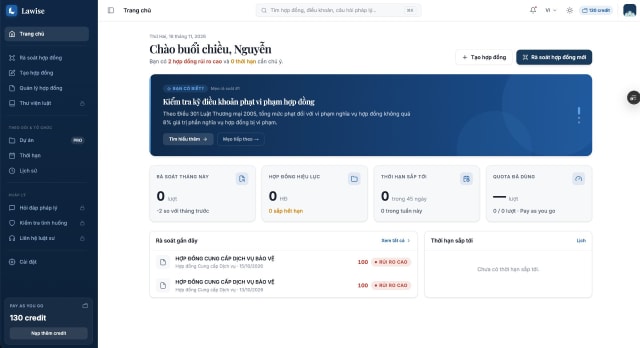
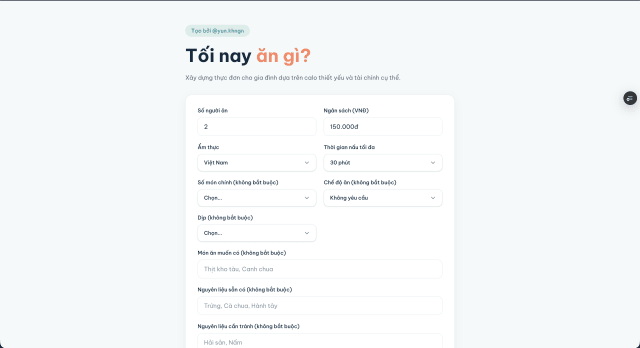
Explore the building process of 'AI Kitchen' - a space where I turn raw ideas into complete products by optimizing my AI workflow.

On this page
From Idea to Product: The Philosophy of AI Kitchen
Throughout my software development journey, I have always sought to optimize not just my code, but my 'thought process'. People often talk about AI as a content generation tool, but to me, AI is a tireless colleague within a complex information processing machine. I call this system 'AI Kitchen'.
AI Kitchen is not a single tool. It is an ecosystem of prompts, scripts, and workflows connecting various models (such as Claude Sonnet, GPT) to process input data. Much like a kitchen, the input is 'raw ingredients' and the output is refined 'dishes' (technical products).
Why AI Kitchen?
Most engineers today use AI in a 'chat-and-go' manner: ask a question, get an answer, copy-paste code. This works well for isolated tasks, but becomes extremely risky when building large systems. AI Kitchen focuses on three core principles:
Modularization: Breaking down complex tasks into small 'recipes'. Each prompt is a single step in the workflow.
Validation: Every AI output must pass through a verification filter.
Context Awareness: Keeping AI aligned with the project context instead of sending isolated prompts.
Operational Workflow: How are 'ingredients' processed?
Step 1: Preprocessing
Before feeding any request to Claude, I always clean the data first. I usually use Python scripts to extract essential structures from documents (markdown, codebases, logs) and remove noise. This is similar to prepping vegetables before cooking. AI performs much better when it doesn't have to read redundant information.
Step 2: Task Separation (Chain-of-Thought Prompting)
Instead of asking: 'Write an API service for me', I break down the process:
Persona Definition: Define the role of the AI.
Architectural Guidelines: Provide architectural principles (e.g., Hexagonal Architecture, Clean Code).
Implementation Phase: Write detailed code.
Review Phase: Self-review code and spot potential bugs.
Here is an example of a 'Recipe' (prompt recipe) structure that I often use for code refactoring tasks:
[Role]: Senior Software Engineer
[Context]: Project uses TypeScript and Next.js 14
[Task]: Refactor the current fetch logic into a React Query hook.
[Guidelines]:
- Use functional components
- Ensure proper error handling
- Type all interfaces strictly
- No magic strings
[Step-by-step]:
1. Analyze existing code structure.
2. Identify side effects.
3. Propose the new hook implementation.
Building the Evaluation System (The Taste Test)
In a real kitchen, the chef tastes the food before serving. In AI Kitchen, I apply a Self-Correction mechanism. When receiving AI feedback, instead of accepting it immediately, I ask the AI to perform a re-check using an adversarial prompt:
'Act as a Security Auditor and find security vulnerabilities in the code written above.'
This significantly reduces basic logic errors that AI typically makes. We should never blindly trust the first returned result.
Integrating into Personal Workflow
For AI Kitchen to be truly effective, it needs to live right inside the workflow. I have integrated supporting tools like VS Code extensions, combined with custom scripts to send requests directly via the Claude API. This allows me to avoid constant context switching between the IDE and the browser.
Storing 'prompt templates' as a code library on GitHub is also how I manage 'ingredients' for the system. Whenever there is a new project, I simply clone this library, change the context, and start the workflow.
Challenges and Limitations
Of course, AI Kitchen is not a cure-all. There are limitations you should keep in mind:
Hallucinations: AI may invent non-existent libraries or impractical solutions. Human validation is mandatory.
Context Window Constraints: Although current models support very large contexts, providing too many unnecessary details still reduces AI performance.
Cost Management: Continuous API calls for small tasks can become costly if not properly controlled.
The Future of AI Kitchen: Towards Agentic Workflow
Currently, AI Kitchen still requires my active participation (Human-in-the-loop). However, I am moving towards building 'AI Agents' capable of autonomously operating preprocessing and validation steps without heavy manual intervention.
In the future, I want to integrate AI Kitchen with [CI/CD tool name] so that dishes (code) are pushed directly to the staging environment after passing automated tests. That is when this kitchen becomes a fully automated production line.
Conclusion
AI does not replace engineers, but engineers who use AI effectively will undoubtedly surpass the rest. Building a systematic workflow (like how I am building AI Kitchen) is the only way to maintain speed and quality in today's rapidly changing tech environment.
What about you? What is your workflow with AI? Feel free to share below.
Repo: https://github.com/yunkhngn/AI-kitchen-code-delivering
Keep exploring