Engineering · 2026-11-15 · 11 min read
Beautiful on the Surface, Engineered Underneath - My Legacy Website
Building a Personal Website into a Microservice Platform. An engineering retrospective on building a design-driven personal website backed by a microservice architecture, computer vision experiments, automated Docker builds, and production infrastructure."
On this page
01. It was supposed to be just a personal website
I have always believed that a personal website should be more than a collection of links and project cards.
It is a place where you can express how you think, what you create, and how you see the digital world. I wanted mine to feel intentional - not just visually, but also in the way people interacted with it.
The initial motivation was simple: build a personal space to showcase my work, share what I was learning, and experiment with ideas that I couldn't quite explore in academic projects.
But I have a habit of taking things further than originally planned.
I started spending more time thinking about interactions, transitions, layouts, and the overall visual language. I wanted every element to feel like it belonged there. The interface needed to be beautiful, but it also needed to feel coherent and effortless to navigate.
Then came the engineering questions.
What should happen behind the interface? How should content be managed? Could different capabilities operate independently? How could I introduce AI-powered features without making the core application unnecessarily complicated?
Eventually, the project evolved into something much bigger than a personal website.
It became a microservice-based platform that I designed, developed, deployed, and maintained independently.
02. Design was never an afterthought
One of the most memorable aspects of this project was the feedback I received after sharing it with the developer community.
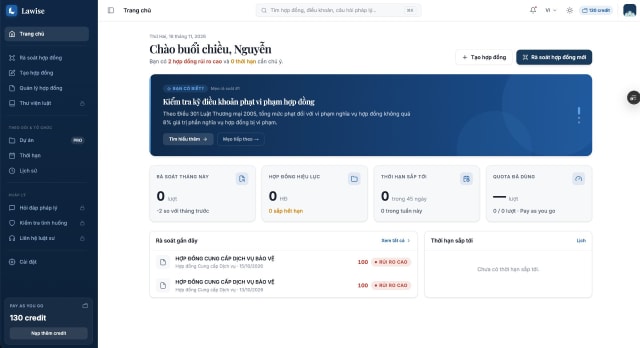
People noticed the UI, the visual design, and the technology stack behind it. Seeing developers appreciate both the appearance and the engineering was particularly rewarding.
That meant a lot to me because the visual experience was never something I added at the end.
I wanted the website to have its own identity.
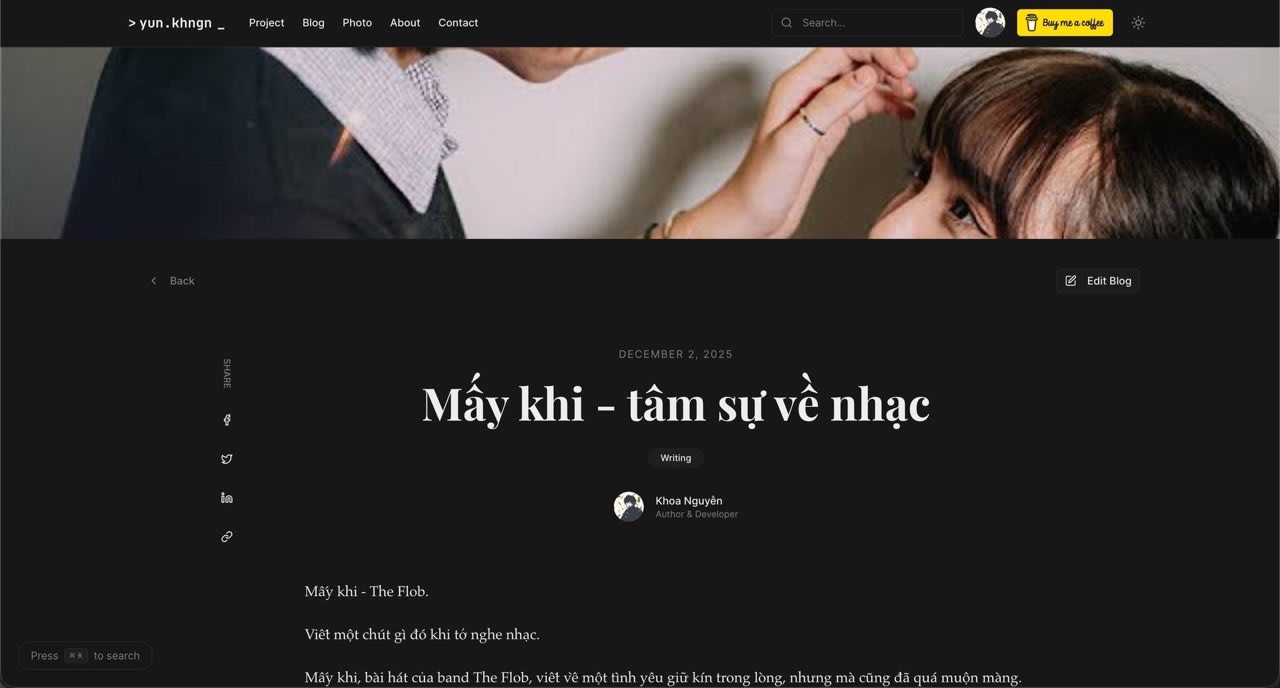
Rather than simply following a conventional portfolio layout, I approached it as a product. I paid attention to visual hierarchy, spacing, typography, component consistency, interaction states, and motion.
I wanted the experience to feel polished without becoming unnecessarily complicated.
There was also an interesting challenge here: a technically sophisticated system does not automatically produce a good user experience.
The complexity should remain behind the scenes. Visitors should not need to understand the architecture, databases, or APIs to enjoy using the website.
That became one of the principles I tried to follow throughout development:
Make the experience simple. Let the engineering do the heavy lifting.
03. From a website to a distributed system
As the platform grew, its responsibilities became increasingly diverse.
The frontend needed to serve different types of content and interactions. The backend handled business logic, content management, and data access. Authentication needed its own boundaries. I also wanted to experiment with computer vision without tightly coupling Python-based processing to the main application.
Instead of putting everything into a single codebase and runtime, I gradually separated the system into dedicated services.
The architecture eventually consisted of five main components:
ComponentTechnologyResponsibilityFrontendNext.js, ReactPublic website, interactive experiences and admin interfaceBackendNestJS, PrismaCore APIs, business logic and data managementAuthenticationNestJS, Firebase Admin SDKAuthentication and authorizationAI ServicePython, FastAPI, OpenCVImage processing and computer visionInfrastructureDocker Compose, CaddyContainer orchestration, routing and deployment
The backend was organized around different application domains, including blogs, galleries, projects, comments, and other content-related features.
I also worked with repository patterns to keep data access separate from business logic, making individual modules easier to maintain and extend.
The interesting part was not simply having multiple services.
It was learning how to define responsibilities, manage communication between components, and understand the operational implications of distributing an application across different runtimes.
A microservice architecture looks attractive on a diagram, but maintaining one is a different experience entirely.
Every service introduces another deployment unit, another configuration boundary, and another potential point of failure.
I learned that separation creates flexibility, but it also creates responsibility.
04. The technology behind the experience
One of the reasons this project became such an interesting engineering playground was the variety of technologies involved.
I wanted to explore tools that solved different problems rather than choosing a stack simply because it was popular.
Frontend
The frontend was built around Next.js and React.
It handled the public-facing experience, content presentation, interactive components, and administrative workflows.
My focus was on keeping the application responsive and maintaining a consistent design system while allowing different parts of the website to have their own interaction patterns.
Backend
NestJS provided the structure for the backend services.
I used Prisma for database access and organized the application into modules with relatively clear responsibilities.
The backend also integrated with external services for media management, email delivery, authentication, and AI-powered functionality.
Infrastructure and supporting services
Docker became the foundation for packaging and running the application.
The platform also used several supporting technologies:
Redis: Caching and supporting application workflows.
Microsoft SQL Server: Relational data storage.
ChromaDB: Vector storage for AI-related experiments.
Caddy: Reverse proxy and automatic HTTPS.
Cloudinary: Image hosting and media transformation.
Firebase: Authentication infrastructure.
Google Gemini: AI-powered functionality.
Resend: Transactional email delivery.
Socket.IO: Real-time communication.
Each technology served a particular purpose within the ecosystem.
More importantly, integrating them gave me experience working with different types of systems and understanding how they fit together in a real application.
05. An unexpected experiment with computer vision
One of my favorite parts of this project was an experiment involving handwritten letters.
I wanted to create a more personal reading experience — something that could reveal handwriting progressively, almost as if someone were writing the letter in front of the visitor.
A conventional text animation would not achieve the effect I wanted.
The animation needed to understand the actual structure of the handwriting.
So I built a dedicated image-processing service using Python, FastAPI, and OpenCV.
The idea was to analyze a handwritten image and generate a corresponding reveal map that the frontend could use to control the animation.
The processing pipeline involved several techniques:
1. Contrast enhancement
I used CLAHE (Contrast Limited Adaptive Histogram Equalization) to improve local contrast and make faint handwriting more distinguishable from the background.
2. Image thresholding
I experimented with Otsu thresholding and Gaussian Adaptive Thresholding to separate ink strokes from the paper background.
This was important because handwritten images are rarely perfectly clean. Lighting conditions, paper texture, and scanning quality can all affect the result.
3. Line detection
Using horizontal projection analysis, I identified text-line regions and their approximate positions.
This helped the system understand the spatial structure of the handwriting instead of treating the entire image as one continuous shape.
4. Reveal map generation
The processed image was converted into a normalized grayscale map containing values from 1 to 255.
The frontend could then use these values to control how individual regions of the handwriting became visible over time.
I also designed the processing flow to work asynchronously, allowing the service to accept a processing request and return the result through a webhook once the work was completed.
This feature was particularly interesting because it connected several areas I enjoyed exploring: computer vision, backend architecture, asynchronous processing, and frontend animation.
It was a good reminder that sometimes a great interaction begins with understanding the data underneath it.
06. Automating the journey to production
Building the application was only half of the experience.
I also wanted to understand how to operate it in a real production environment.
I deployed the platform to a DigitalOcean Droplet and built an automated deployment workflow around GitHub Actions and Docker.
Rather than manually building images and transferring them to the server, I wanted the build process to be repeatable.
The pipeline worked roughly as follows:
Changes were pushed to GitHub.
GitHub Actions triggered the relevant build workflow.
Docker images were built for the corresponding services.
Successfully built images were published as Docker packages to GitHub Container Registry (GHCR).
The production environment pulled the published images and updated the running containers.
This approach separated the build process from the production runtime.
The server did not need to build the application from source every time a new version was released. It could simply retrieve the prepared Docker images and run them.
I also used Docker Compose to manage the services and Caddy to handle reverse proxy configuration and automatic HTTPS through Let's Encrypt.
Other infrastructure considerations included:
Container health checks and service dependencies.
Persistent volumes for application data.
Internal Docker networking.
Reverse proxy configuration.
Database backup scripts.
Security headers and request handling.
Service lifecycle and deployment management.
For me, this was one of the biggest steps forward in the project.
I went from thinking about how to make an application work to thinking about how to build, ship, and operate it consistently.
The deployment pipeline was not the most visible part of the website, but it was one of the things that made the whole system feel like a real engineering project.
07. Building in public
At some point, I started sharing the project with other developers.
I was particularly happy to receive positive feedback from people in the Vietnamese developer community, including J2TEAM Community.
What stood out to me was that people were interested in different aspects of the project.
Some appreciated the visual design and UI/UX. Others were surprised by the technology stack and the amount of engineering behind what was, at first glance, just a personal website.
That combination was exactly what I had been trying to achieve.
I didn't want to build something that was technically impressive but difficult to use.
Neither did I want to create a beautiful interface that was only a static presentation with no meaningful engineering behind it.
I wanted both sides to complement each other.
Receiving that kind of feedback gave me a lot of motivation to continue experimenting and improving the platform.
It also reminded me why sharing personal projects matters. Sometimes, putting something you have built out into the world gives you a perspective that you cannot get from working on it alone.
08. More than 1,700 commits later
The project eventually reached a point where its original repository structure no longer reflected how I wanted to preserve and present it.
The services had initially been developed in separate repositories, each with its own history and development workflow.
I later consolidated the project into a single repository for archival purposes, preserving the development history across its different components.
The repository now contains more than 1,700 commits.
For me, preserving that history was important.
I didn't want the project to exist only as a final snapshot of the codebase. I wanted to keep the iterations, experiments, and decisions that shaped it.
Looking through the history is a reminder of how much the project changed from its original idea.
Some decisions were good. Some were unnecessarily complicated. Some features existed simply because I wanted to find out whether I could build them.
And I think that is what makes a personal engineering project interesting.
It doesn't always follow the most efficient path. Sometimes the journey itself is the point.
09. What I would do differently today
Looking back, there are several things I would approach differently if I were rebuilding the platform today.
Not every boundary needs to be a microservice
Separating responsibilities is valuable, but introducing independently deployed services too early can create more complexity than necessary.
I would spend more time identifying domain boundaries before deciding which components should become separate services.
Observability should come earlier
Health checks are useful, but knowing whether a container is running is not the same as understanding the behavior of a distributed system.
I would invest earlier in centralized logging, metrics, tracing, and better operational visibility.
Infrastructure costs matter
Running multiple services, databases, caches, and supporting infrastructure introduces costs.
For a personal project, these decisions need to be evaluated carefully.
A more sophisticated architecture is not automatically a better architecture.
Design and engineering should evolve together
Perhaps the most important lesson was that neither design nor engineering should be treated as a finishing step for the other.
The architecture should support the experience, while the experience should influence architectural decisions.
A technically impressive system is only meaningful when it serves a real purpose.
10. Looking back
This project started with a simple desire: I wanted a personal website that represented me.
Somewhere along the way, it became a much larger engineering experiment involving distributed services, computer vision, databases, automated Docker builds, cloud infrastructure, and production deployment.
It also became one of the projects that received some of the most memorable feedback from the developer community.
Looking back, I don't think the most important achievement was using a particular framework, implementing a microservice architecture, or running everything on a cloud server.
It was learning how different disciplines could come together to create one cohesive experience.
Design taught me to care about what people see and feel.
Engineering taught me to care about what happens underneath.
And building this project gave me the opportunity to explore both.
Would I make the same architectural decisions today? Probably not. I have learned enough to recognize where I could simplify things.
But I am glad I went through the process.
Because sometimes, a personal project doesn't need to become a business or a product to be worth building.
Sometimes, it just needs to challenge you enough to become something you are proud of.
Beautiful on the surface. Engineered underneath.
Project archive
Case Study: yunkhngn.dev/work/yunkhngn-microservice-platform
Source Code: github.com/yunkhngn/legacy-yunkhngn-microservice-website
Developer: yunkhngn.dev
Designed, engineered, and deployed independently by yunkhngn.
Keep exploring