Indie Chess
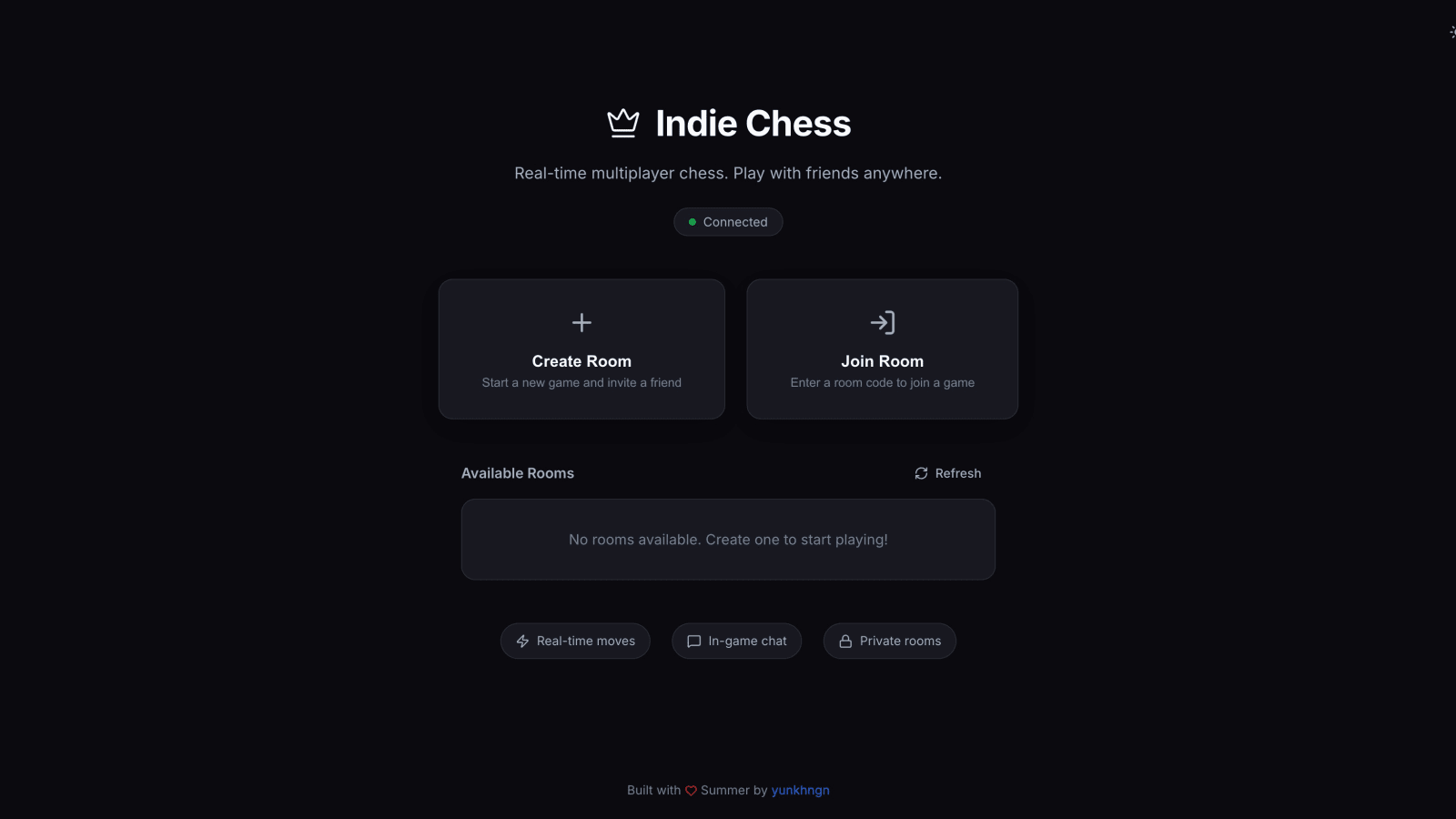
A real-time multiplayer chess application with room management, chat, and various time controls, offering an engaging online platform for chess enthusiasts.
Case study
Project Overview
Indie Chess is a comprehensive real-time multiplayer chess application designed to bring an interactive and engaging online chess experience to users. It provides a platform where players can create and join virtual rooms, compete against opponents with instant move synchronization, and communicate through an in-game chat system. The project's core purpose is to offer a robust and feature-rich environment for playing chess online, complete with essential functionalities like time controls, move validation, and reconnection support.
Core Technologies
The application is built using a modern full-stack architecture, leveraging key technologies to ensure a smooth and responsive user experience.
Frontend with React
The frontend is powered by React 18 and Vite, providing a dynamic and responsive user interface. The react-chessboard library is utilized for rendering the interactive chess board, while Socket.IO Client handles real-time communication with the backend, ensuring instant updates for moves and chat messages. React Router manages navigation within the application.
Backend with Node.js and Socket.IO
The backend is built with Node.js and Express, serving as the API and central server logic. Socket.IO is the cornerstone for real-time bidirectional communication, enabling instant synchronization of chess moves, clock updates, and chat messages between players. The chess.js library is crucial for server-side move validation and managing game state, ensuring fair play. bcrypt is used for securely hashing room passwords.
Deployment and Infrastructure
For deployment, the project utilizes Docker Compose, which containerizes both the frontend and backend services for consistent environments. Caddy acts as a reverse proxy, simplifying HTTPS setup and domain management.
Key Features
Real-time Gameplay: Instantaneous move synchronization via WebSockets for a fluid playing experience.
Room Management: Players can create public or password-protected rooms and invite others to play.
Chess Clock: Comprehensive support for multiple time controls, including Bullet, Blitz, Rapid, and Classical formats.
In-game Chat: A built-in chat system allows players to communicate with their opponents during a game.
Robust Game Logic: Server-side move validation using
chess.jsprevents illegal moves and ensures fair play.Reconnection Support: Players can rejoin active games seamlessly after temporary disconnections.
PGN Export: Option to download game notation in Portable Game Notation (PGN) format.
Responsive Design: The application offers a responsive layout, making it playable on both desktop and mobile devices.
Technical Challenges
Real-time State Synchronization: Implementing reliable and efficient synchronization of game state, including moves and clocks, across multiple clients in real-time using WebSockets, while accounting for latency.
Robust Game Logic Implementation: Developing and integrating complex chess rules, move validation, and intricate time control mechanics on the server-side to ensure an authoritative and cheat-proof game environment.
Reconnection Handling: Designing a resilient system to allow players to gracefully rejoin games after a disconnection, maintaining their previous game state and preventing disruptions.
Scalability of WebSockets: Managing multiple concurrent WebSocket connections and maintaining individual room states efficiently to support a growing number of players and games.
Security Considerations: Ensuring the integrity of game logic, protecting against illegal moves, and securing room access with password hashing to prevent unauthorized entry.
What I Learned
Mastering WebSocket Communication: Gained a deep understanding of `Socket.IO` for building robust, event-driven real-time applications, including strategies for reliable data exchange, error handling, and managing persistent connections.
Full-stack State Management in Real-time: Learned to effectively manage complex application state across both frontend (React) and backend (Node.js) in a highly dynamic, real-time environment, ensuring data consistency and responsiveness.
Designing for Resilience: Developed an appreciation for building fault-tolerant systems through features like reconnection support and comprehensive server-side game validation, crucial for a seamless user experience in networked applications.
Containerization and Deployment Workflows: Practiced using Docker and Docker Compose to create consistent development and production environments, along with configuring Caddy for automated HTTPS and efficient reverse proxying.
Game Logic Implementation: Gained experience in integrating specialized libraries like `chess.js` on the server to implement authoritative game logic, ensuring fairness and correctness in a multiplayer setting.
Complexity
Intermediate
Justification: This project is categorized as intermediate due to its full-stack nature, reliance on real-time WebSocket communication, and the implementation of complex game logic. It requires careful state management across both client and server, handling issues like connection drops, and ensuring server-side authority for game rules. The use of Docker for containerization and Caddy for automated HTTPS further adds to its professional development practices, making it significantly more complex than a basic CRUD application but not yet venturing into highly distributed or extremely large-scale systems.
Keep exploring
Related work
From the journal

Next project
Better Sleep →