Wattpad Clone - Whatapp
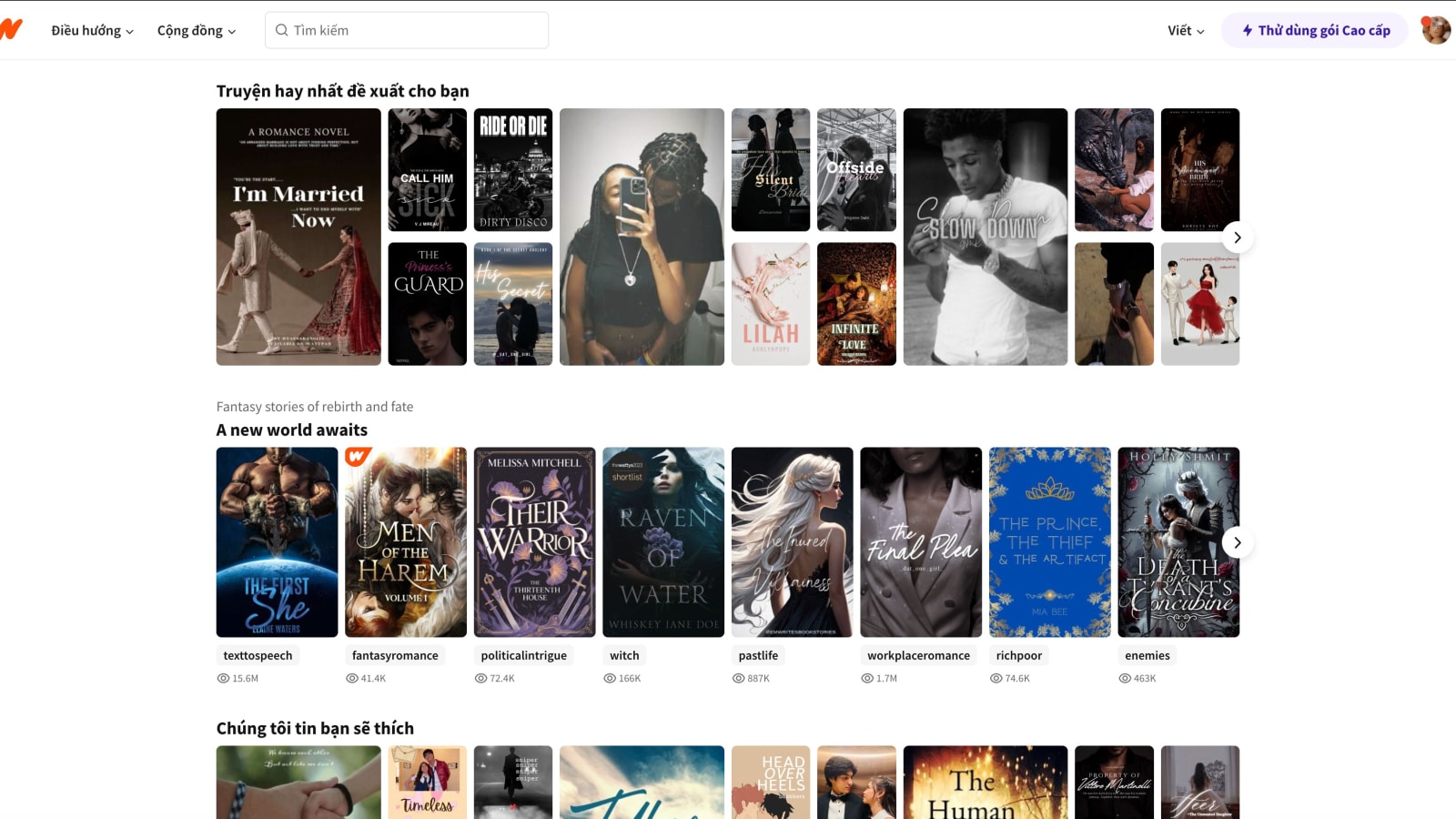
A full-stack minimalist Wattpad clone built to learn web development. Features story/chapter CRUD, reading, author following, voting, and commenting, powered by React, Node.js, Express, SQL Server, and Cloudinary.
Case study
Project Overview
This project, named "Whatapp", is a minimalist full-stack clone of the popular story-sharing platform Wattpad. It was developed with the primary goal of providing a comprehensive learning experience in full-stack web development. The application focuses on implementing core functionalities found in such platforms, allowing users to create, manage, and read stories, interact with authors and content through following, voting, and commenting.
Core Technologies
The application is built using a modern full-stack architecture, leveraging robust and widely-used technologies.
Frontend
React: Utilized for building a dynamic and responsive user interface, providing a component-based approach to UI development.
React Router: Manages client-side routing, enabling seamless navigation between different sections of the application without full page reloads.
React Bootstrap: Provides a responsive and mobile-first approach to styling and UI components, accelerating development and ensuring a consistent look and feel.
Backend
Node.js and Express: Form the backbone of the server-side, offering a fast, scalable, and efficient environment for building RESTful APIs.
bcryptjs: Used for securely hashing user passwords, ensuring that sensitive authentication data is protected.
jsonwebtoken (JWT): Implemented for token-based authentication, providing a stateless and secure method for verifying user identity across API requests.
multer: Handles multipart/form-data, specifically for processing file uploads such as story cover images.
mssql driver: Facilitates the connection and interaction between the Node.js backend and the SQL Server database.
Database & Media Storage
SQL Server 2022: A powerful relational database chosen for its reliability and robust features, storing all structured application data. Its NVARCHAR support ensures proper handling of Unicode characters.
Cloudinary: An external cloud service integrated for efficient and scalable storage of media files, such as story cover images, offloading asset management from the primary server.
Key Features
User Authentication: Secure registration and login functionalities, leveraging bcrypt for password hashing and JWT for session management.
User Profiles & Following: Users can create profiles and follow their favorite authors, enhancing community interaction.
Story Management: Authors can create new stories with titles, descriptions, cover images, and tags, with options to publish or save as drafts.
Chapter Management: Stories can be organized into chapters, allowing authors to define order, publish status, and update content.
Reading Experience: Users can read stories chapter by chapter, with progress tracking to remember their last read position.
Engagement Tools: Features include voting on chapters and a threaded commenting system for discussions.
Personalized Reading Lists: Users can curate public or private reading lists to organize their favorite stories.
Content Discovery: A search functionality enables users to find stories by title, description, or tags.
Technical Challenges & Solutions
Developing this full-stack application presented several learning opportunities and technical challenges. A significant challenge was establishing robust and secure user authentication and authorization across the frontend and backend, which was addressed by implementing JWT for stateless authentication and bcrypt for secure password hashing. Another key area was managing complex relational data in SQL Server, involving meticulous database schema design to handle interconnections between users, stories, chapters, comments, and reading lists. Integrating an external media storage solution like Cloudinary required careful handling of file uploads via multer and securely storing only the image URLs in the database, decoupling media storage from application data. The project also involved ensuring seamless communication between the React frontend and Node.js/Express backend through well-defined RESTful APIs, covering CRUD operations and user interaction flows.
What I Learned
Gained practical experience in building and integrating a complete full-stack application, connecting a React frontend with a Node.js/Express backend and a SQL Server database.
Mastered the implementation of secure user authentication using password hashing (bcrypt) and token-based authorization (JWT).
Successfully integrated a third-party cloud service (Cloudinary) for scalable and efficient media storage, learning about file upload handling and external API interactions.
Developed a strong understanding of relational database design and management with SQL Server, particularly for complex schemas involving multiple interconnected entities.
Improved skills in designing and consuming RESTful APIs, focusing on clean endpoints, data validation, and error handling.
Complexity
Intermediate: This project demonstrates an intermediate level of complexity. It goes beyond basic single-technology applications by integrating a comprehensive full-stack setup including a modern frontend framework (React), a robust backend (Node.js/Express) with full authentication (JWT, bcrypt), a relational SQL Server database with a non-trivial data model, and an external cloud service (Cloudinary) for media management. While it doesn't delve into highly advanced topics like microservices, complex real-time features, or distributed systems, the breadth of technologies and integrated features positions it firmly in the intermediate category, offering a solid foundation in contemporary web development practices.
Keep exploring
Related work
From the journal
Next project
AutoParking - Smart Parking Management IoT System →