MedConnect
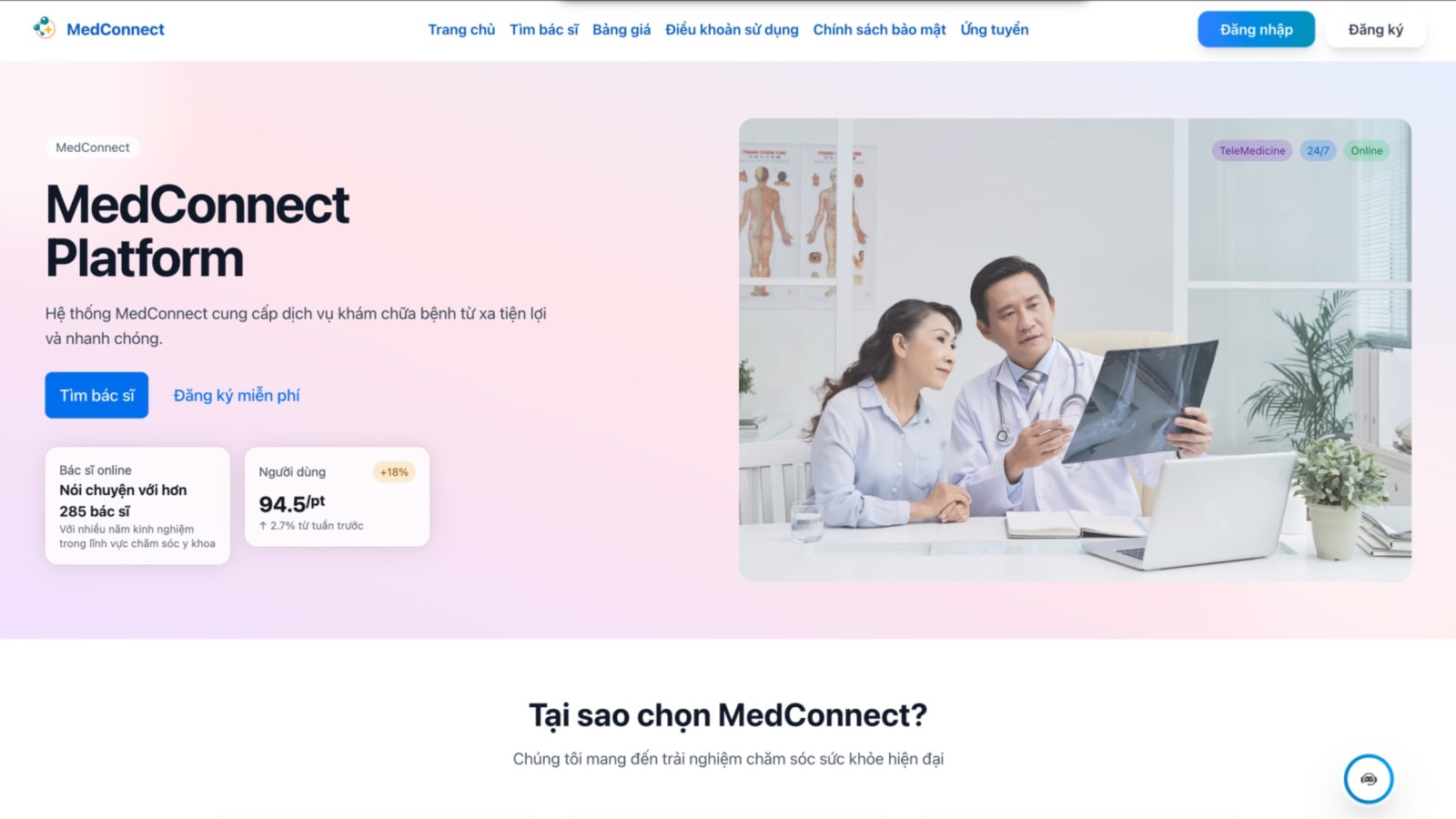
A comprehensive healthcare management system connecting patients, healthcare providers, and administrators through a modern web platform.
Case study
Project Overview
MedConnect is a robust, full-stack healthcare management system designed to modernize and streamline operations for patients, healthcare providers, and administrators. It addresses the critical need for an integrated digital platform that facilitates efficient patient management, appointment scheduling, secure medical record keeping, and even virtual consultations. The system aims to enhance communication, improve operational efficiency within healthcare facilities, and provide a seamless experience for all stakeholders involved.
Core Technologies
Java 21 & Spring Boot 3.5.6: Powering the robust backend, Java 21 and Spring Boot provide an enterprise-grade, scalable, and secure foundation for handling complex business logic, data persistence, and API development. Its comprehensive ecosystem and mature tooling are ideal for mission-critical applications like healthcare systems.
Next.js 15.3.1, React 18.3.1 & TypeScript 5.6.3: The frontend is built with Next.js, leveraging React for dynamic UI components and TypeScript for strong type safety and improved code maintainability. This combination ensures a performant, scalable, and developer-friendly experience for building interactive web interfaces, supported by Tailwind CSS for utility-first styling and Framer Motion for smooth animations.
SQL Server 2022: Chosen as the primary database, SQL Server 2022 offers a powerful and reliable solution for storing sensitive patient data, medical records, and administrative information. Its robust features for data integrity, security, and scalability are essential for a healthcare application.
Docker Compose: For seamless development and deployment, Docker Compose orchestrates the entire application stack, including the backend, frontend, and database. This ensures a consistent environment across different systems, simplifying setup, configuration, and scaling of services.
Firebase & Gemini API: The project integrates Firebase for authentication and potentially other services, providing a robust and scalable user management solution. The inclusion of the Gemini API suggests advanced features, possibly for AI-driven insights or functionalities within the system.
Key Features
Patient Management: Enables comprehensive patient registration, detailed profile management, and maintenance of their medical history.
Appointment Scheduling: Provides a robust system for booking, managing, and tracking appointments for patients and providers.
Medical Records: Offers secure digital storage and management of sensitive medical records, ensuring accessibility and compliance.
Provider Portal: Equips healthcare professionals with tools for practice management, patient interaction, and administrative tasks.
Telemedicine: Facilitates virtual consultations, allowing patients to connect with doctors remotely, enhancing accessibility to care.
Admin Dashboard: Provides administrators with a centralized interface for facility management, user oversight, and system configuration.
Technical Challenges
Full-Stack Integration: Successfully integrating a Java/Spring Boot backend with a Next.js/React frontend, including managing API communication, authentication flows (Firebase), and data synchronization.
Containerized Deployment: Orchestrating multiple services (database, backend, frontend) using Docker Compose, including managing environment variables, port mappings, and ensuring services start in the correct order for a stable local and production environment.
External API Integrations: Implementing and securing integrations with third-party services like Firebase for authentication and the Gemini API for advanced functionalities, handling credentials and API calls securely.
Data Management and Security: Designing a robust database schema (SQL Server) for sensitive healthcare data and ensuring data integrity, security, and proper ORM mapping with Hibernate for the backend.
What I Learned
Building Distributed Systems: Gained extensive experience in architecting and developing a multi-service application, understanding the benefits and challenges of separating frontend, backend, and database layers.
Advanced Docker & Containerization: Mastered Docker Compose for orchestrating complex application stacks, including database setup, service dependencies, and mock data loading, ensuring consistent development and deployment environments.
Robust API Design & Consumption: Developed skills in designing secure and efficient RESTful APIs with Spring Boot and consuming them effectively from a Next.js frontend, managing state and data flow across the application.
Firebase & AI Integration: Learned to integrate Firebase for authentication and explored the potential of AI capabilities by including the Gemini API, expanding knowledge of external service integration patterns.
Database Schema & ORM Management: Enhanced understanding of designing relational database schemas in SQL Server and leveraging Hibernate/JPA in Spring Boot for seamless object-relational mapping and data persistence.
Project Complexity: Advanced
Justification: MedConnect is an Advanced project due to its comprehensive nature, involving a full-stack architecture with distinct backend (Java/Spring Boot) and frontend (Next.js/React/TypeScript) applications, a dedicated SQL Server database, and complex orchestration using Docker Compose. The integration of external services like Firebase for authentication and Gemini API for advanced functionalities, coupled with the management of sensitive healthcare data and mock data generation, indicates a sophisticated understanding of modern software development principles and enterprise-grade tooling. It goes beyond standard CRUD applications by tackling multiple user roles, real-time features (telemedicine implied), and robust deployment considerations.
Keep exploring
Related work


From the journal

Next project
Yunkhngn Microservice Platform →